

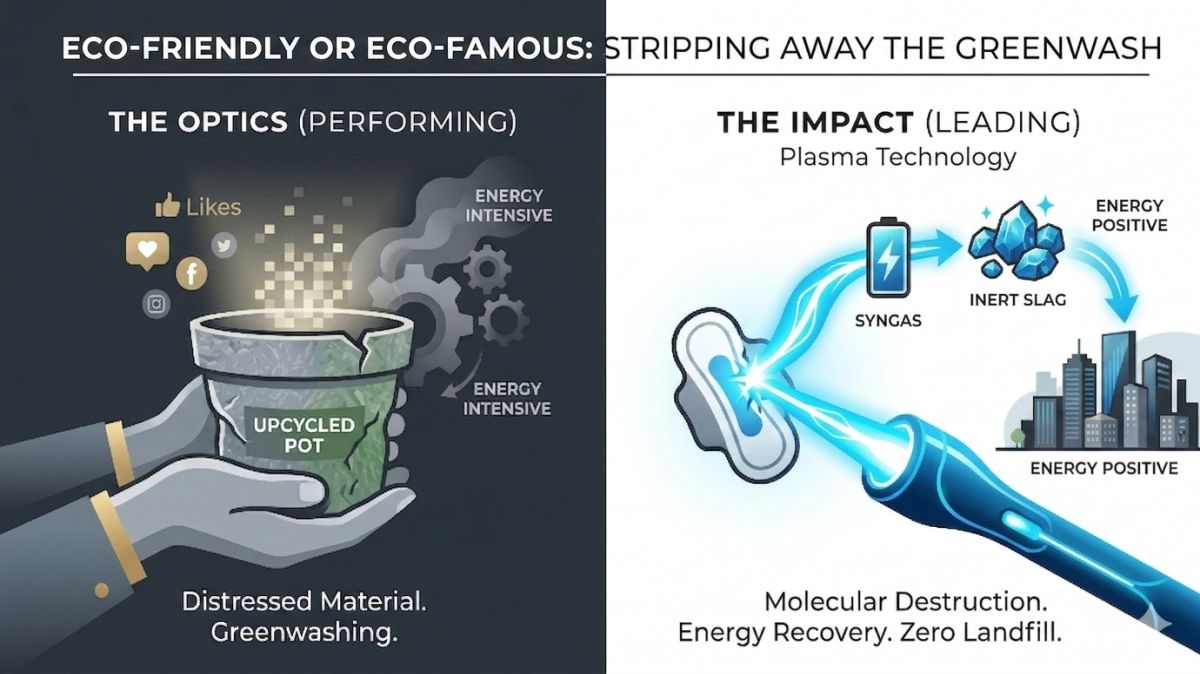
Eco-friendly or Eco-Famous: Stripping away the GreenWash.
In the modern boardroom, "Circularity" has become a magic word—a linguistic shield used to bypass the laws of thermodynamics and the realities of the balance sheet.
As stewards of significant capital and global resources, corporate leaders have a fiduciary and moral mandate to distinguish between genuine innovation and expensive cosplay. Currently, a trend is sweeping through ESG reports: the "upcycling" of sanitary pads. On the surface, it’s a PR dream—transforming bio-hazardous waste into "useful" products. Beneath the surface, it is a thermodynamic failure and a social trap.
Before you sign off on the next "green" initiative, it’s time to look past the buzzwords and face the cold, hard physics of the supply chain.
- The Thermodynamic Deficit: Burning Mountains to Save Pebbles
The fundamental law of sustainability is simple: the resources saved must exceed the resources consumed to save them.
Sanitary pad recycling fails this test spectacularly. To "recover" low-grade plastic from a fused composite of wood pulp, polymers, and human bio-waste, the process requires:
- Massive Thermal Sterilization: Autoclaving at extreme temperatures to handle bio-hazards.
- Chemical Stripping: Using aggressive bleaching agents to neutralize odors and stains.
- Mechanical Deconstruction: High-energy shredding of materials designed to stay bonded.
The Reality: You are burning mountains of fossil-fuel energy and generating chemical effluent just to extract a few "pebbles" of brittle, greyish plastic. If your process emits more carbon than manufacturing virgin material, you aren't saving the planet; you are just greenwashing your own carbon footprint.
2. The "Mongrel" Material Crisis
Recycling is not a "Get Out of Jail Free" card for material quality. The output of pad recycling is, by definition, distressed material.
The heat of sterilization degrades the polymers, and chemical bleaching weakens the fibers. What remains is "glorified trash"—structurally unreliable material that cannot be used for medical or high-end industrial applications. Because of the "yuck factor" and poor durability, these materials are down-cycled into items like plastic flower pots or trinkets that nobody actually wants.
This doesn't solve the waste problem; it just turns your recycling plant into a very expensive, slow-motion landfill.
3. The Social Justice Blind Spot
Corporate "solutions" often have unintended victims. When subsidized "green" startups flood the market with plastic pots or bricks made from sanitary waste, they aren't just recycling—they are displacing local artisans.
The Hidden Cost: In many regions, the production of flower pots from natural soil is a generational trade. When a high-tech fad replaces a low-carbon, human-centric industry (like a local potter) with a high-carbon, machine-centric one, it isn't progress. Sustainability that ignores social justice is merely environmental elitism.
4. The Courage to Choose Destruction
The most difficult task for a leader is to admit that recycling isn't always the answer. Sometimes, the most sustainable act is to remove a hazard from the biosphere entirely rather than trying to "resuscitate" it.
Plasma-based Incineration (Plasma Gasification) is the scientifically superior alternative. By subjecting waste to temperatures between 5,000°C and 14,000°C, it breaks matter down at the molecular level.
- Total Destruction: 100% of pathogens and bacteria are eliminated instantly.
- Energy Recovery: It produces syngas that can be used to generate electricity, making the process a self-sustaining power source.
- Zero Landfill: It leaves behind only a sterile, glass-like "slag" that can be safely used in road construction.
The Verdict: Stop Polishing the Problem
Real leadership requires moving past "Golden Words" and performing a rigorous Life Cycle Assessment (LCA), and truly invested in Net Environmental Impact?
The goal should not be to keep a bio-hazard in the economy; the goal is to neutralize it. Industry Captains should really be looking closely and reconsider promoting in "upcycled" trinkets that the world doesn't need. Start investing in decentralized, high-efficiency solutions that actually leave the world cleaner.
Choose data over decorum. Choose physics over fads.